
Agency & Community
Workforce Development
Live Virtual Workforce Development for Agency & Community Partners
Strengthening Workforce Capacity.
Building Sustainable Community Response.
Our Agency & Community Workforce Development Programs equip organizations with the knowledge, practical tools,
and collaborative strategies needed to improve multidisciplinary responses to hoarding and excessive clutter.
Participants build a shared framework for communication, coordination, and intervention while gaining access to
continued learning and professional development opportunities beyond the training.
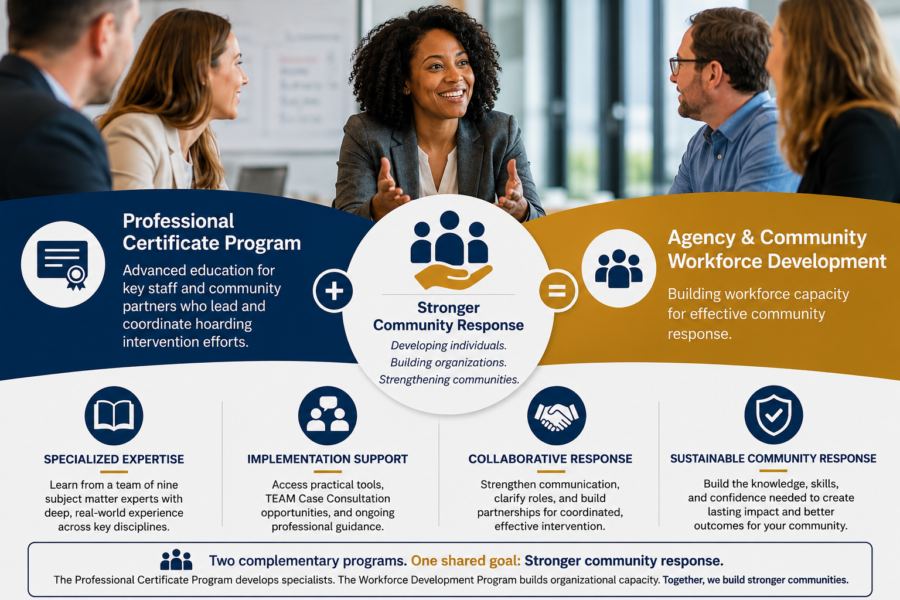
The Professional Certificate in Community Hoarding Intervention prepares key agency staff and community partners to lead and coordinate hoarding intervention efforts through advanced education, practical tools, TEAM Case Consultation opportunities, and 12 months of continuing education and professional support.
However, successful community outcomes rarely depend on one individual alone.
Sustainable community responses require knowledgeable supervisors, engaged leadership, informed frontline staff, and strong collaboration among the agencies and community partners responding to hoarding and excessive clutter.
To support that broader need, the Center for Hoarding offers Live Virtual Agency & Community Workforce Development Programs.
These workforce development programs provide agencies, departments, and community partners with a shared understanding of hoarding disorder, trauma-informed engagement, harm reduction, risk reduction, and collaborative community response. Participants gain practical, evidence-informed strategies that strengthen communication, clarify roles and responsibilities, improve coordination across organizations, and build the capacity needed to respond more effectively to complex hoarding situations.
Participants who complete Hoarding: Identifying, Assessing, Addressing earn a Certificate in Community Hoarding Response and receive 90 days of complimentary access to the Continuing Education & Professional Support Program, extending learning beyond the training through advanced courses, 6 TEAM Case Consultation opportunities, expert guidance, and ongoing professional support.
Participants who complete Hoarding: Developing Sustainable Networks, Teams & Community Partnerships receive a Certificate of Completion for that training.
Together, the Professional Certificate in Community Hoarding Intervention, the Certificate in Community Hoarding Response, and the Continuing Education & Professional Support Program create a common framework and shared language that helps communities move beyond crisis response toward coordinated, sustainable intervention.
While the Professional Certificate in Community Hoarding Intervention is strongly recommended for key staff responsible for leading hoarding intervention efforts, participation in the Professional Certificate Program is not required to schedule an Agency & Community Workforce Development Program. Organizations may choose workforce development training as a standalone option or combine it with the Professional Certificate Program to build both individual expertise and organizational capacity.
Our Agency & Community Workforce Development Programs are led by a team of experts in hoarding intervention and community response. The same subject matter experts who teach our Professional Certificate in Community Hoarding Intervention also deliver workforce development training, bringing specialized expertise in assessment, trauma-informed engagement, motivational interviewing, harm reduction, housing stability, case coordination, and multidisciplinary community response.
With decades of combined experience working with individuals, families, agencies, and communities affected by hoarding and excessive clutter, our training team combines evidence-informed instruction with practical real-world application. Participants leave with strategies and tools that can be immediately implemented to strengthen communication, improve collaboration, and build more effective community responses.
Training 1:
Community Hoarding Response
Training Availability & Scheduling
This training is offered exclusively to agencies, departments, organizations, and community groups. Training dates are scheduled directly with the requesting agency and are not offered as open enrollment events to the general public.
Included with
Agency & Community Workforce Development Training
✔ Certificate in Community Hoarding Response
✔ 3 Months of Continuing Education & Professional Support
Participants who successfully complete the Community Hoarding Response training receive the Certificate in Community Hoarding Response and 3 months of complimentary access to the Continuing Education & Professional Support Program, extending learning beyond the training through advanced education, consultation, and ongoing professional support.
- Advanced topic trainings
- 6 TEAM Case Consultation opportunities
- Expert guidance
- Ongoing professional support
Training Overview
Community Hoarding Response is a comprehensive live virtual training for agencies, departments, and community partners who support individuals affected by hoarding and excessive clutter. Participants build a shared understanding of hoarding disorder while developing practical strategies for compassionate, coordinated community response.
Training Title: Community Hoarding Response
Identifying, Assessing & Addressing Hoarding Cases in Community Settings
Trainer: Varies
Contact Hours: 6
Contact: marnie@centerforhoardingandcluttering.com
Training Summary
This live virtual training provides agency staff, supervisors, leadership, and community partners with a practical foundation in hoarding disorder, trauma-informed engagement, harm reduction, and collaborative community response.
Through lecture, case examples, discussion, and interactive learning activities, participants develop practical strategies that strengthen communication, clarify roles, and support safer, more coordinated community intervention.
Training Agenda & Learning Outcomes
Focus Area 1: Understanding Hoarding Disorder
- Understand hoarding disorder as a mental health condition.
- Distinguish hoarding from other clutter-related situations.
- Explore stigma, misconceptions, and community impact.
Focus Area 2: Empathy, Empowerment & Engagement
- Apply trauma-informed communication strategies.
- Build trust while reducing resistance.
- Promote realistic, collaborative outcomes.
Focus Area 3: Harm Reduction & Collaborative Community Response
- Apply harm reduction principles to improve safety.
- Strengthen multidisciplinary collaboration.
- Clarify agency roles and shared responsibilities.
By the end of the training, participants will better understand their role in supporting compassionate, coordinated, and sustainable hoarding intervention efforts within their agency and community.
Ready to Build Your Community’s Workforce Capacity?
Whether you’re looking to train an entire workforce, prepare key staff through the
Professional Certificate in Community Hoarding Intervention, or combine both approaches through our workforce development bundle, compare all program options, included benefits, credentials, continuing education, consultation opportunities, and investment levels to determine the best fit for your organization.
For additional information about training options, scheduling availability, agency registration, invoices, W-9s, or customized workforce development solutions, please contact us.
Training 2:
Hoarding: Developing Sustainable Networks, Teams & Community Partnerships
Training Availability & Scheduling
This community capacity-building training is offered quarterly and is designed for agencies, task forces, community leaders, certificate holders, and community partners interested in strengthening local systems, resources, and collaborative responses to hoarding.
Unlike agency-specific trainings, this program is offered as an open enrollment event. Registration is completed on an individual basis rather than by agency, allowing participants from multiple organizations and communities to learn, collaborate, and share ideas together.
Announcements and registration information will be distributed to Professional Certificate holders, client agencies, community partners, task force members, and other professionals connected to the Center for Hoarding’s training and consultation programs.
Training Overview
Live virtual training for agencies, departments, task forces, community leaders, and individual professionals seeking to strengthen collaborative community responses to hoarding and excessive clutter. Participants explore how to build sustainable partnerships, improve coordination, and increase community capacity.
Training Title: Hoarding: Developing Sustainable Networks, Teams & Community Partnerships
Trainer: Varies
Contact Hours: 3
Contact: marnie@centerforhoardingandcluttering.com
Training Summary
This live virtual training helps agencies, departments, task forces, and community partners strengthen their ability to respond to hoarding situations through collaboration, coordination, and resource development.
Through discussion, guided planning exercises, and real-world examples, participants gain practical strategies for developing multidisciplinary partnerships, building sustainable support networks, and creating coordinated systems that improve outcomes for residents and communities.
Training Agenda & Learning Outcomes
Focus Area 1: Understanding Collaborative Community Responses
- Explore why hoarding is most effectively addressed through collaborative community approaches.
- Identify common community response models and multidisciplinary strategies.
- Assess current strengths, challenges, and opportunities for improvement.
Focus Area 2: Building Effective Community Partnerships and Teams
- Identify key community partners and stakeholder groups.
- Strengthen communication and coordination across agencies.
- Clarify roles, responsibilities, and shared goals within community response systems.
Focus Area 3: Capacity Building and Sustainable Community Solutions
- Develop strategies for building community resources and reducing stigma.
- Support task forces, multidisciplinary teams, and long-term partnerships.
- Create sustainable systems that improve community response over time.
By the end of the training, participants will better understand how to build, strengthen, and sustain collaborative community responses that improve outcomes for individuals, agencies, and the communities they serve.